Spotted Sandpiper
Actitis macularius



About the Spotted Sandpiper
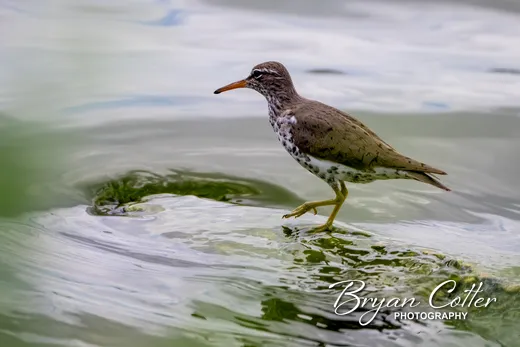
The Spotted Sandpiper is the shorebird that follows you around the lake - the teetering little sentinel of nearly every water edge in North America, from Gulf jetties to mountain creeks. No bird of its size behaves like it: a constant, rhythmic tail-bobbing walk, then a burst of stiff, shivering wingbeats low across the water, wings never seeming to rise above the horizontal.
In breeding plumage it wears bold dark polka-dots below (the "spotted" of the name); winter and young birds are plain white beneath with a clean brown wedge at the shoulder. It hunts the waterline alone, picking insects, small crustaceans, and larvae from mud, rock, and wrack with quick darting stabs.
Spotted Sandpipers run one of the bird world's most famous role reversals: females arrive first, claim and defend territories, court the males, and may pair with up to four in a season - leaving each male to incubate his own clutch and raise the chicks. The system, called polyandry, is vanishingly rare in birds, and this species is its textbook example.
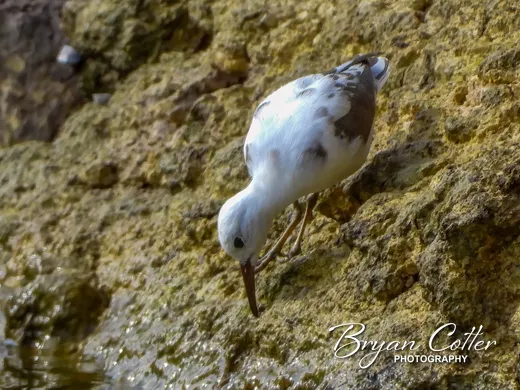
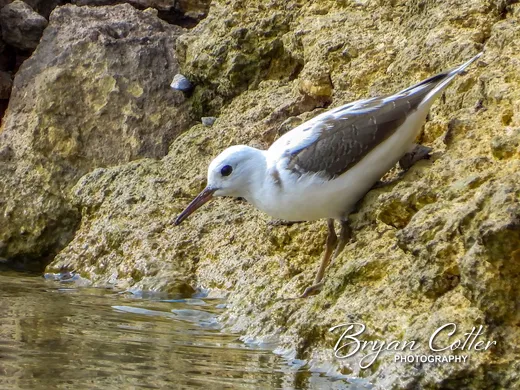
In Texas the Spotted Sandpiper is an abundant migrant and winter bird on every kind of shoreline, present most of the year though it breeds mainly to the north. The individual in these photographs is leucistic - a genetic condition that strips melanin from some or all of the plumage, leaving a mostly white bird with normal dark eyes and bare parts. Unlike a true albino (pink-eyed, fully pigmentless), a leucistic bird is simply missing paint, and this pale sandpiper still teeters and flutters exactly like its ordinary kin.
Join one of my guided birding tours! Fine art prints of my photos are also available.
© 2026 Bryan Cotter Photography camera gear privacy policy terms of use site by cotter designs