Walking Stick
Diapheromera femorata

About the Walking Stick
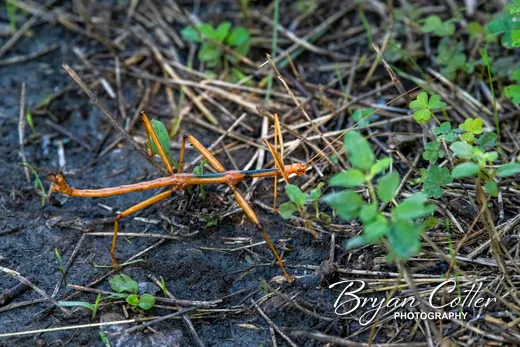
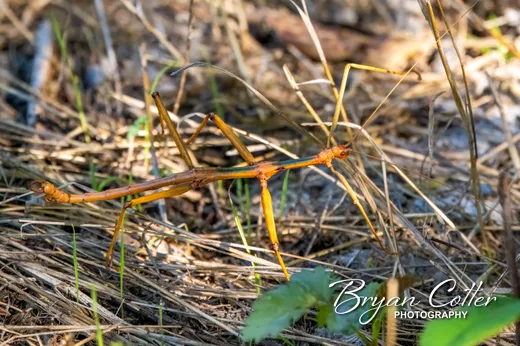
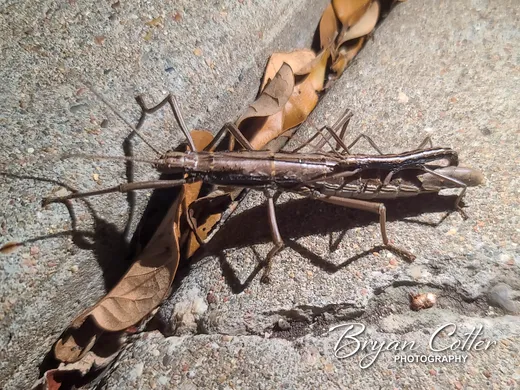
An insect that has committed entirely to looking like a twig. The body is a long thin cylinder, the legs are thinner still and held out along the axis of the body when at rest, and the whole animal is brown or green with faint mottling. Females are considerably larger than males and often a plainer brown; males are more slender and frequently marked with darker bands.
The camouflage is behavioural as much as physical. A disturbed walkingstick will freeze, and if a breeze moves the surrounding leaves it sways gently in time with them. Handled, it may drop straight to the ground and lie still, or shed a leg - a lost limb can be partly regrown at the next moult if the insect is young enough.
Females scatter their eggs by simply dropping them from the canopy, one at a time, to the leaf litter below. The eggs look like plant seeds, complete with a fatty cap that ants find attractive, so ants carry them underground where they are safe from predators and freezing. They overwinter there, sometimes for two winters, and the nymphs climb back up in spring.
Common across the wooded eastern half of Texas, walkingsticks are far more numerous than anyone notices, since a motionless twig-shaped insect on a twig is almost never spotted.
Join one of my guided birding tours! Fine art prints of my photos are also available.
© 2026 Bryan Cotter Photography privacy policy terms of use site by cotter designs