Ringed Kingfisher
Megaceryle torquata




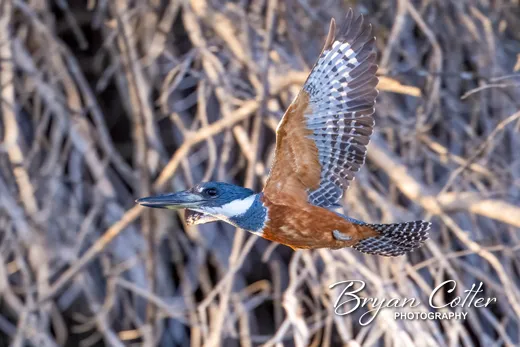
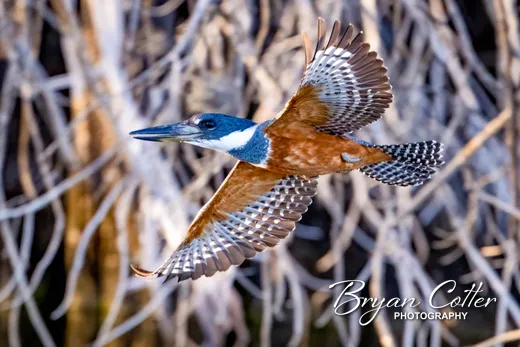
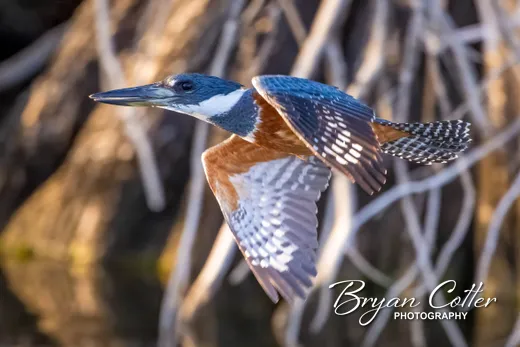
About the Ringed Kingfisher
The largest kingfisher in the Americas and a genuinely imposing bird - half again the bulk of a Belted Kingfisher, with a massive dagger of a bill and a heavy shaggy crest. The upperparts are slate blue-gray, there is a white collar around the neck, and the entire underside from the breast down is deep rufous. The female adds a blue-gray band across the chest above the rufous. A Belted Kingfisher, by contrast, is white-bellied.
It hunts from a high exposed perch over water, or by hovering, then drops in a heavy plunge that goes right under. The call is a harsh rattling that is slower, lower, and far louder than a Belted's - often the first sign one is on the river, carrying well before the bird comes into view.
Ringed Kingfishers nest in burrows, digging a tunnel several feet into a vertical earth bank above water and laying at the end of it.
In Texas this is fundamentally a Rio Grande bird. It first nested in the United States in the 1970s and remains reliable along the river and the resacas of the Valley. It has been working its way up the Colorado and other river systems since, so a Ringed Kingfisher in Central Texas is a good local bird - not a once-in-a-lifetime record, but well worth the drive when one is reported.
Join one of my guided birding tours! Fine art prints of my photos are also available.
© 2026 Bryan Cotter Photography privacy policy terms of use site by cotter designs