House Sparrow
Passer domesticus


About the House Sparrow
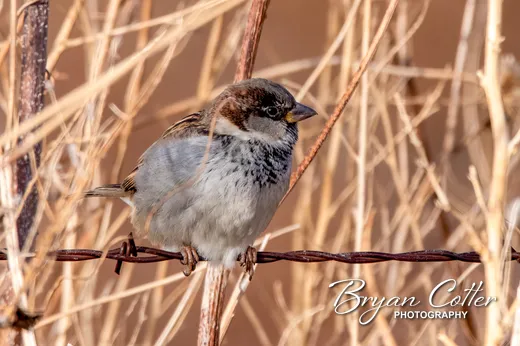
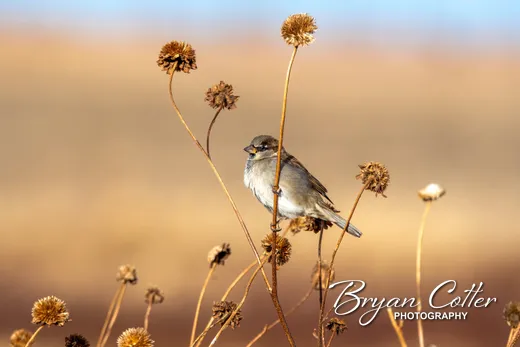
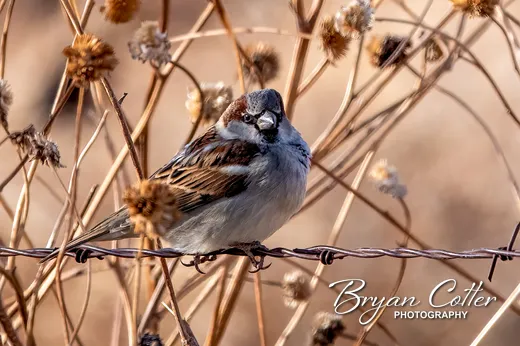
The bird everyone has seen and almost nobody looks at. A breeding male is genuinely handsome when you do: a gray crown bordered in rich chestnut, a black bib spreading from the chin across the breast, pale cheeks, and a heavy black bill. Females and young are plainer - warm brown above with dark streaking on the back, dingy buff below, and a pale stripe behind the eye - and are often mistaken for native sparrows, though the unstreaked breast and stout build give them away.
House Sparrows are social, noisy, and permanently attached to people. They feed on the ground in loose flocks, dust-bathe in bare dirt, and roost communally in dense shrubs and signage. The male's song is not much of a song at all, just a repeated cheep delivered from a gutter or wire, and a colony keeps up a running chatter through the day. Pairs stay together year-round rather than re-forming each spring.
They are cavity nesters, and this is where they cause trouble. A pair will fill any hole - a vent, a light fixture, a traffic signal, a nest box - with a bulky untidy mass of grass and feathers, raise two or three broods a season, and aggressively evict native cavity nesters such as bluebirds and Purple Martins, sometimes destroying eggs and young to take a box.
Introduced to New York in the 1850s, the species spread across the continent within decades and is now a year-round fixture in every Texas town. Numbers have actually been falling for years across much of its introduced range, a decline that remains only partly explained.
Join one of my guided birding tours! Fine art prints of my photos are also available.
© 2026 Bryan Cotter Photography privacy policy terms of use site by cotter designs