Thistle Grasshopper
Aeoloplides sp.
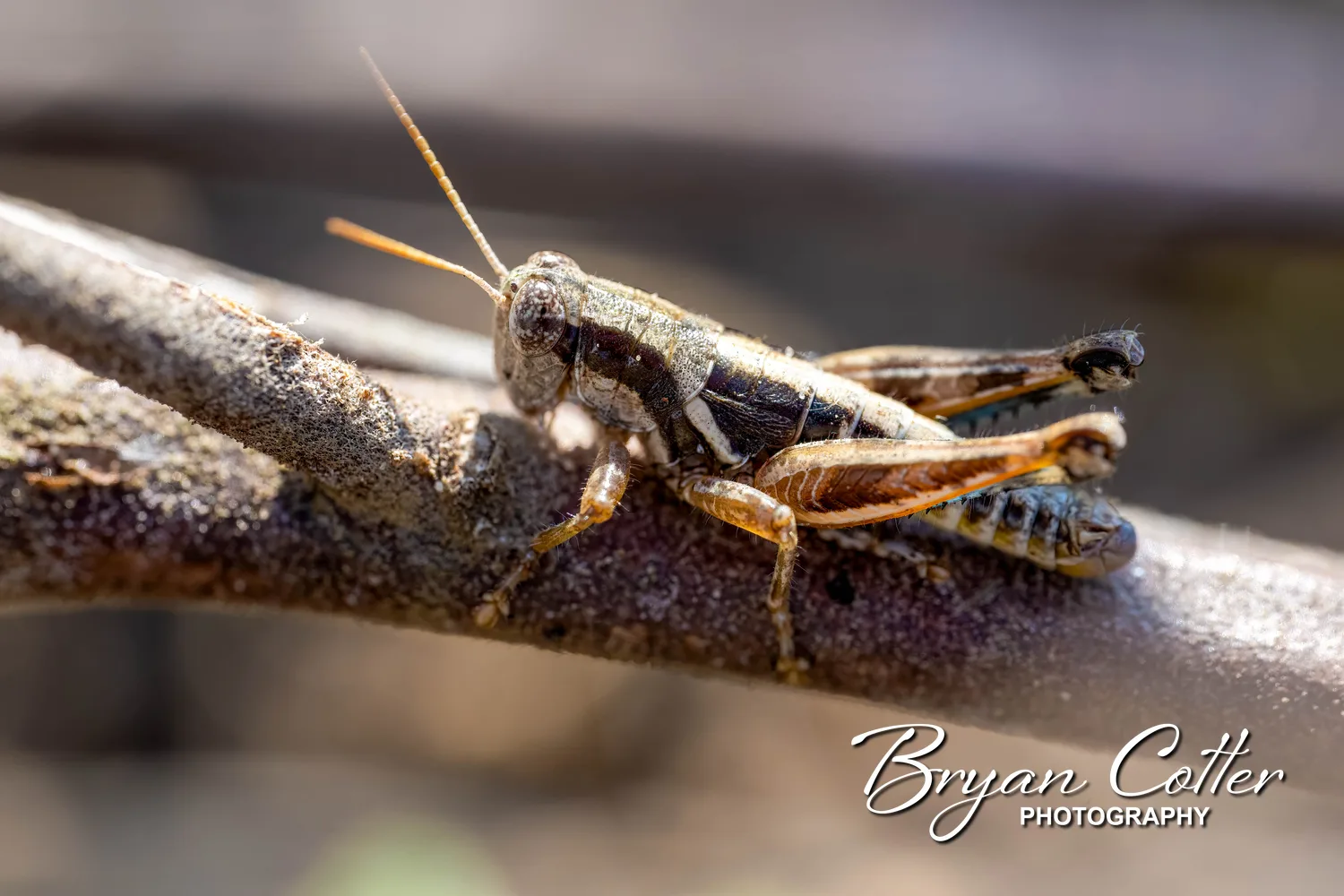
About the Thistle Grasshopper
A short-horned grasshopper about an inch long, built low and compact, and closely matched to the dry winter brush it sits in. The ground color is tan and gray, broken by a bold dark band that starts behind the eye, runs back across the side of the pronotum, and carries on along the body, edged above in cream. The strongest color is on the hind leg: the femur is marked with heavy dark herringbone chevrons over a pale ground and washed orange along its lower margin, and the tibia below it is a soft blue-gray set with black-tipped spines. The wings reach past the end of the abdomen, marking a fully grown adult.
Thistle grasshoppers are not grass feeders. They are broadleaf specialists, living on saltbush, thistle, and their relatives, and they tend to stay put on a host plant rather than bounding away across open ground the way a rangeland grasshopper does. Approached, one will usually sidle around to the far side of a stem and freeze, betting on the camouflage - which is why they are found perched in plain view instead of flushing from underfoot.
The life cycle runs on a single generation a year. Females push the tip of the abdomen into loose soil at the base of a host plant and lay a pod of eggs there in the fall; those eggs overwinter, and the nymphs emerge in spring to feed and molt through a series of stages on the same kind of plant the adults use. Adults appear in late summer and can persist into the first hard cold.
In Texas they belong to the brushy country of the west and south, wherever their host plants grow thickly, and adults run from late summer well into the fall - so a warm late-November morning on a South Texas ranch is still good for one.
Join one of my guided birding tours! Fine art prints of my photos are also available.
© 2026 Bryan Cotter Photography privacy policy terms of use site by cotter designs